
BTS: Creating a Case Study-Focused Portfolio: Watch the Full Journey
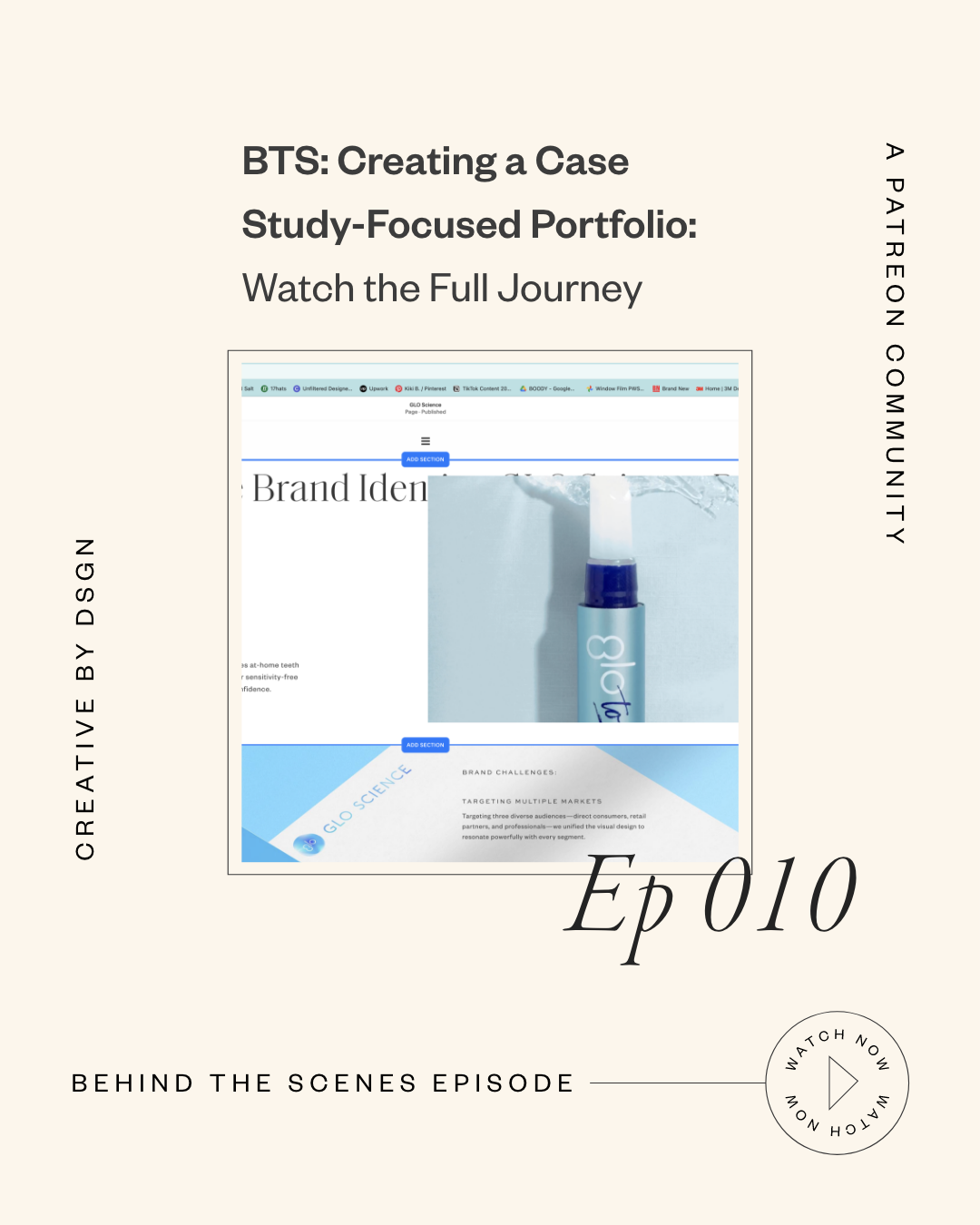
If you’ve ever looked at your portfolio and thought…
“Okay, the work looks good… but why does this still feel kind of… meh?” 😅
Same.
And honestly? That’s exactly why I made this episode (and now this blog post), because I realized something that kind of hurt my feelings a little bit:
I had great brand work sitting on my website… and it looked like I tossed it up there in five minutes with zero context.
Like yes — the visuals were pretty.
Yes — the brand design itself was solid.
But the portfolio page wasn’t doing what it was supposed to do:
✨ Tell the story
✨ Show my thinking
✨ Prove my expertise
✨ Sell my process
So today I’m walking you through exactly how I took one brand project — GLO Science — and transformed it into a full case study that actually feels like an agency-level portfolio piece.
We’re going to cover:
what a case study really is (and why it matters)
examples of case studies that are so good they’ll make you want to redesign your whole website
how I planned my GLO Science case study layout in Adobe XD
how I brought it to life in Squarespace (with motion + GIFs + video)
and the biggest portfolio tip I wish someone had drilled into me years ago
Let’s get into it.
First… What Even Is a Case Study?
A lot of designers treat case studies like they’re just “pretty portfolio pages.”
But a real case study is deeper than that.
A case study is essentially a story that explains:
✅ what the client needed
✅ what the challenge was
✅ what strategy you used
✅ what you designed
✅ and how the final work solves the problem
This applies to brand design, package design, creative strategy, web design, and even things like an illustration process if your work is more artistic or visual.
Because clients aren’t just hiring you for the final logo or packaging.
They’re hiring you because you can think.
They want to trust your process.
And a good case study is proof that you know what you’re doing.
This is exactly why I take a strategy-first approach to my projects—because the visuals should always be backed by intention. If you’re curious what that looks like, you can explore my design services here.
Where I Get Case Study Inspiration (and Why It Changed Everything)
Okay so I’m going to tell you my favorite place to find high-level design inspiration lately:
Typewolf.
I know Typewolf is “technically” a typography resource, but what’s cool is that so many of the websites featured on there are for agencies and designers — and when you click through, you get this insane goldmine of portfolio case study examples.
Example 1: Julia Lloyd Moore (Minimal + Clean)
Julia’s portfolio is super minimal, but still really intentional. One thing I love is the scroll layout — where her name and title stay anchored, while her work scrolls beside it.
When you click into a project, she doesn’t just show the work. She includes:
what the project was
what kind of client it was
the services provided
and then multiple applications of the brand
Even without tons of written explanation, you still understand the scope.
And she includes motion too — which is huge.
Example 2: Thoughtful Design (Strategic Storytelling)
Now this is where the case study gets spicy. 🌶️
Thoughtful Design does an incredible job of blending:
business context
creative strategy
and visual execution
One of my favorite examples is their project “Halter,” where they explain the product, the audience, the insight, and then how the insight directly shaped the brand.
They don’t just say “we made a logo.”
They explain why the logo works.
That’s the difference.
They even break down concepts like:
the logo system
how it transforms
why it visually relates to the product story
That is case study GOLD.
And if you do package design, this kind of storytelling matters even more because packaging isn’t just aesthetics — it’s about shelf impact, differentiation, and brand clarity.
The Big Case Study Secret: Show Your Thinking (Not Just the Final Assets)
Here’s what I noticed after studying all these examples:
The best case studies don’t just show mockups.
They show:
the problem
the thought process
the creative decisions
and the strategy
Even UX/UI designers do this really well. They literally write:
“This was the challenge. Here’s what I tried. Here’s why I did it this way.”
And it instantly positions them as someone who solves problems — not someone who just makes things “look good.”
If you want to charge more for brand design, package design, or creative direction?
This is how you do it.
What My GLO Science Portfolio Page Looked Like Before 😭
So let’s talk about GLO Science.
Before I redesigned this case study, my Squarespace page was basically…
✨ A couple pretty images
✨ A random “mood board” section
✨ Some mockups
✨ And that’s it
No explanation. No story. No strategy. No context.
And when I look back at it now, it felt unfinished — like I didn’t even care enough to explain what I did.
And obviously I did care. I put a lot of effort into the brand.
But my portfolio page didn’t reflect that.
So I asked myself:
“How do I make this feel like a real case study?”
Why I Moved the Whole Thing into Adobe XD First
I originally tried to fix the case study directly in Squarespace…
And it was not working. 😅
Because when you’re building in Squarespace, you’re kind of working in a narrow tunnel. You can’t see the full story all at once.
I needed to zoom out.
So I moved everything into Adobe XD first.
Not because XD is magical — but because it let me:
✅ see the full page layout
✅ plan the flow of the story
✅ organize sections clearly
✅ and build the “experience” before building the actual web page
This part alone was a game changer.
If you design websites, you already know this — but even if you don’t, using a layout tool first helps you avoid that messy “guess and drag blocks around” energy.
The GLO Science Case Study Structure I Created
Here’s the flow I built for my GLO Science case study:
1) Start with what GLO Science IS
I wrote a concise intro explaining the brand in a way that sounds premium:
“At the intersection of science and soul, GLO Science revolutionizes at-home teeth whitening…”
That kind of intro immediately sets the stage and makes the work feel elevated.
2) Highlight the Brand Challenges
This is where the case study becomes a case study.
GLO Science had real challenges, like:
appealing to multiple target markets
using a cool color palette while still communicating “warm glow”
standing out in a competitor-heavy space where everyone uses blue
creating innovative packaging that felt different
That’s not just design — that’s creative strategy.
3) Show the behind-the-scenes concepts
This was my favorite part.
I had so many ideas, revisions, and concepts that didn’t make it into the final deliverables… but they mattered.
So I created a “mood board reel” showing unused concepts and inspiration — basically proof of how much thought went into the project.
4) Add motion + animation
This is where the portfolio level-up happens.
I created:
logo gradient animations
brand guide GIF overviews
icon animations
packaging concept motion clips
Motion makes your work feel modern, high-end, and alive.
Even if you’re not an animator, simple GIFs and video loops go a long way.
And I used CapCut for this because it has such good transitions and effects — way more than Adobe Premiere Rush in my opinion.
5) Mockups on EVERYTHING
This is non-negotiable.
I added mockups showing the brand in multiple places:
packaging
posters
billboards
social media
iPhone mockups
swag (totes, sweatshirts)
hypothetical expansions (like toothpaste)
Because a brand isn’t “real” until you see it living in real life.
And the more places you show it, the more confident people feel in your work.
That’s true for brand design and package design, and even pattern creation or illustration-heavy projects.
What I Learned About Embedding Video in Squarespace (So You Don’t Suffer)
Here’s a practical tip if you use Squarespace:
Some content needs different block types.
GIFs can go into image blocks (depending on size)
iPhone videos often need a video block
larger motion pieces are easier to embed using Vimeo + a code block
That’s what I did.
I embedded my larger videos through Vimeo so the page stayed fast and clean.
Because nothing ruins a case study like a portfolio page that takes 45 years to load.
The Two Biggest Challenges of This Whole Process
Here’s what took the most time:
1) Organizing my thoughts
This was the hardest part.
Because you have the work… but now you need the story.
XD helped with that because it let me map everything visually first.
2) Putting everything in motion
motion takes time.
Even simple GIFs take effort.
But it’s worth it because it’s what separates “decent portfolio” from “agency-level case study.”
My Best Portfolio Tip: Make Case Studies Part of Your Client Process
Okay this is the part I wish I had done YEARS ago:
Instead of redesigning my portfolio years later…
I want to make portfolio updates part of my workflow moving forward.
So the process becomes:
Finish project
Deliver files + offboarding
Follow up with client
Update portfolio case study as the next step
Because design trends change fast.
And five years from now, you might not even love the project anymore (sad but true).
So post it while it’s fresh.
And while it reflects your current level.
Your portfolio is the bread and butter of everything we do.
It helps you book clients.
It helps you raise your rates.
It can even help you land a full-time job.
It matters.
Final Thoughts (and a Little Pep Talk)
If you’re overwhelmed by your portfolio…
I get it.
Redoing case studies takes time. It’s real work.
But the difference it makes in how professional you look — and how confident clients feel — is HUGE.
And you don’t need to make your entire portfolio perfect overnight.
Just start with one.
One case study. One glow-up. One transformation.
And then build from there.
Let’s Talk in the Comments
Okay now I want to hear from you:
What’s the biggest thing you struggle with when it comes to building portfolio case studies?
Is it writing? Mockups? Layout? Knowing what to include? Motion?
Drop a comment and tell me — and if you want, I’ll do a follow-up post showing exactly how I write case study copy (and how I use ChatGPT to help). 💛


